domingo, 22 de abril de 2018

Let's celebrate !

                                                       Holidays and Festivals

                                        Resultado de imagen para chinese new year
                                                             Chinese New Year
                                                          January or February 
                                   Chinese people celebrate with firecrackers and lion dances.

                                       Resultado de imagen para valentines day
                                                                 Valentine's Day
                                                                   February 14
              People in many countries give chocolates, flowers, or jewelry to the people they love.
                                        Resultado de imagen para children day
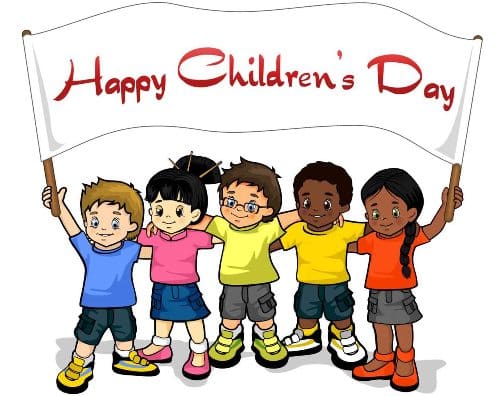
                                                                  Children's Day
                                                                       May 5  
                Japanese families put up colored streamers shaped like fish, in honor of their children.

                                            Resultado de imagen para day of the dead
                                                                      Day of the Dead 
                                                                        November 2   
                         Mexican families offer food to the dead and then have a meal in a cemetery.     


                                                                         GRAMMAR
       

Relative clauses of time

Thanksgiving is a day                                when North Americans celebrate the harvest.
February 14 is the day                               when  people give cards to the ones they love.
New Year's Eve is a day                            when i have fun with my friends.
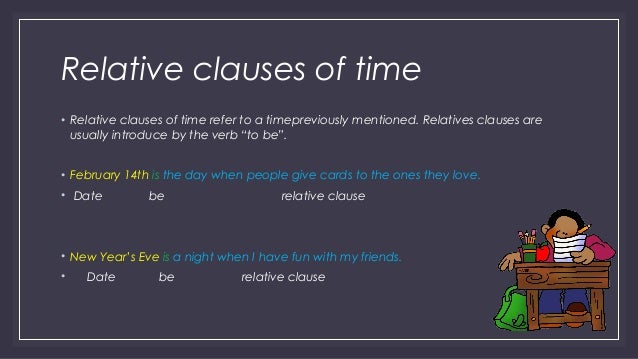
                               Resultado de imagen para relative clauses of time


  Adverbial clauses of time 
When people get married in japan,                          they sometimes have the ceremony at a shrine.
After the food is served,                                           the guests give speeches or sing songs.
Before guests leave,                                                  the bride and groom give them presents.


What's this for?

                                                          GRAMMAR

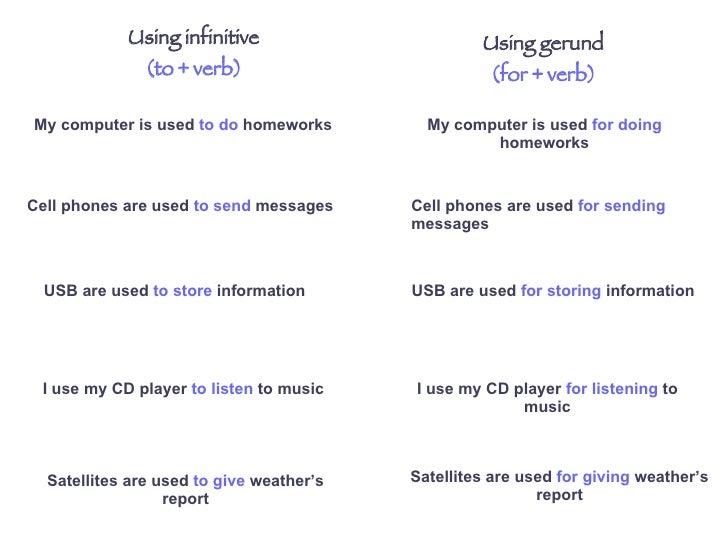
Infinitives and gerund for uses and purposes

Infinitives                                                                 Gerunds
I use my computer to send e-mails.                         I use my computer for sending e-mails.
Computers are often used to pay bills.                    Computers are often used for paying bills.


                             Resultado de imagen para infinitives and imperatives for uses and purposes

                                                                GRAMMAR


Imperatives and infinitives for giving suggestions

Be sure to turn it on.                                                     Remember to pay the bill every moth.
Make sure to hit the "end" button.                                Try not to talk for too long.


sábado, 21 de abril de 2018

OK. No problem

                                                           SNAPSHOT

Common complaints of families with teenagers.

Parents about teens:                                                                 Teen about parents:

Resultado de imagen para kids don't help at house                                         Resultado de imagen para padre regañando a su hijo
My son dont help out around the house.                           My father always tell me what to do.


                                                         GRAMMAR

Two-part verbs

Resultado de imagen para two part verbs

Two-part verbs; will for responding to requests

With nouns                                                           Request and response               
turn down the tv                                                 please turn down the music
turn the tv down                                                 OK. i'll turn it down

Ejemples
Turn the lights off, please.
Clean your boots up, please.
Put the books away.


                                                     GRAMMAR

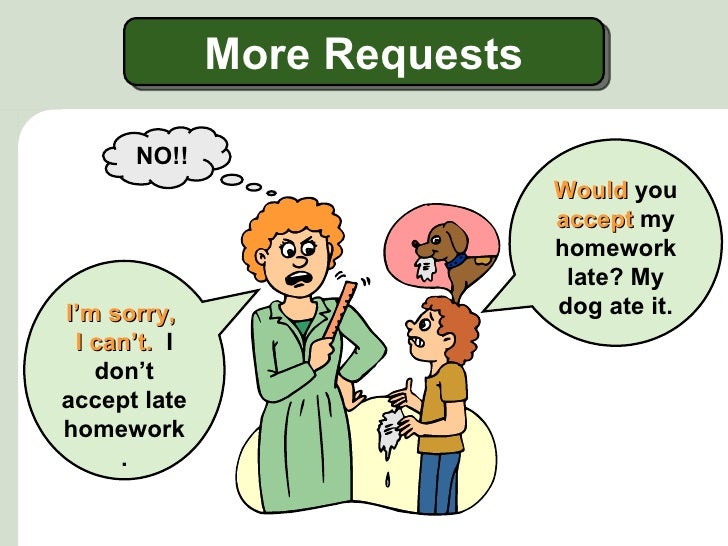
Resquests with modals and would you mind...

Modal + simple form of verb                                    Would you mind ... + gerund
Can you turn the stereo off ?                                   Would you mind turning the stereo down?
Could you close the door, please ?                            Would you mind closing the door, please?

Resultado de imagen para requests with would you mind


martes, 28 de noviembre de 2017

Ethnic Food

"Ethnic food" simply means food that is not part of mainstream cuisine, generally produced by or originating from an ethnic minority group. The word ethnic in itself means "of or relating to a population subgroup (within a larger or dominant national or cultural group) with a common national or cultural tradition. Ethnic food can also be called traditional dishes.

For example:
Carne-de-sol (sun meat), or jabá is a dish from northeastern Brazil. It consists of heavily salted beef, which is exposed to the sun for one or two days to cure.

sábado, 25 de noviembre de 2017

Wish + Past Tense

In English, we use wish + past form verb when we want something now or in the future to be different. 

Example: I wish I had more money. 


In English, we use wish + past perfect verb to show we regret something (we want something in the past to be different) e.g. I wish I had listened to my mom and studied harder.

Evaluation with Adjectives

Evaluation with Adjectives


  • As...as
She was as clear as crystal about her intentions.

  • Too

Too is used to mean more than sufficient or more/less than necessary.
  1. It’s too late to stop him

  • Enough

  1. Enough is used to mean sufficient: 
Your clothes are big enough to fit me.
  • Not Enough 
Enough is used in negative sentences to mean less than sufficient or less than necessary.
  1. You’re not working fast enough, you won’t finish on time.


https://youtu.be/ethbBja46v4 


https://youtu.be/R_H4Ai17jzI

Time For A Change

Adjectives to describe things like houses and apartments!

Positive

  1. Bright                                                        
  2. Comortable
  3. Convenient
  4. Huge
  5. Modern
  6. Private
  7. Quiet
  8. Safe
  9. Spacious 
Negative

  • Cramped 
  • Dangerous
  • Dark
  • Dingy
  • Expensive
  • Inconvenient
  • Noisy 
  • Shabby 
  • Small

COMPARATIVE ADJECTIVES

Comparative adjectives are used to compare differences between the two objects they modify (larger, smaller, faster, higher). They are used in sentences where two nouns are compared, in this pattern:
Noun (subject) + verb + comparative adjective + than + noun (object).
Add -er for the comparative.. If the adjective has a consonant + single vowel + consonant spelling, the final consonant must be doubled before adding the ending.These very common adjectives have completely irregular comparative and superlative forms.
AdjectiveComparative
goodbetter
badworse
littleless
muchmore
farfurther / farther

https://youtu.be/fleok757P90

Indirect Questions With Wh-


Indirect questions start with a phrase like 'could you tell me...' or 'do you know...'. For example: 

Direct question: Where is the bank?
Indirect question: Could you tell me where the bank is?


To make an indirect 'yes / no' question, we use 'if' and the word order of a normal positive sentence. This is the same as for reported 'yes / no' questions. On the other hand, we don't usually need to 'backshift' (change the tense of the verb) as we do with reported questions.


Verb TenseDirect QuestionIndirect Question
Present simple with 'be'Why is he unhappy?Can you tell me why he is unhappy?
Present continuousWhen is the restaurant closing?Can you tell me when the restaurant is closing?
Past simple with 'be'Why was he late for the meeting?Can you tell me why he was late for the meeting?
Past continuousWhat were you doing at 3pm?Can you tell me what you were doing at 3pm?
Present perfectWhere has Lucy been?Can you tell me where Lucy has been?
Present perfect continuousHow long has she been living here?Can you tell me how long she has been living here?
Past perfectWhy had she quit her job before she moved here?Can you tell me why she had quit her job before she moved here?
Past perfect continuousHow long had she been living here when she met you?Can you tell me how long she had been living here when she met you?
Future simple with 'will'When will she start her new job?Can you tell me when she will start her new job?
Future simple with 'going to'When is it going to rain?Can you tell me when it is going to rain?
Future continuousWhat time will Lisa be meeting the boss?Can you tell me what time Lisa will be meeting the boss?
Future perfectWhen will he have finished the report?Can you tell me when he will have finished the report?
Future perfect continuousHow long will he have been studying French when he retires?Can you tell me how long he will have been studying French when he retires?
Modal verbsWhat should we do now?Can you tell me what we should do now?

'Wh' questions for tenses with 'do / does / did':

Sometimes you want to make an indirect 'wh' question using the present simple of any verb except 'be' or the past simple of any verb except 'be'. Usually these tenses make questions by using 'do / does / did'. However, when we want to make indirect 'wh' questions using these tenses, we don't need 'do / does / did'. Instead, we use a question word and then normal positive sentence word order.

Verb TenseDirect QuestionIndirect Question
Present simple with any verb except 'be'Where does David live?Can you tell me where David lives?
Past simple with any verb except 'be'Why did Amanda call John yesterday?Can you tell me why Amanda called John yesterday?

Adverbs of Quantity


Count nouns refer to things that can be divided up into smaller units which are separate and distinct from one another. They usually refer to what can individually be seen or heard

Noncountt nouns refer to things that cannot be counted because they are regarded as wholes which cannot be divided into parts. They often refer to abstractions and occasionally have a collective meaning:


https://youtu.be/iMxEUZbTtmU

Caught in the Rush

Bicycle Lane

Bus Stop

Garage

News Stand

Parking Space

Taxi Stand

Traffic Jam

Traffic Lights

Train Station

Used to

We use 'used to' for something that happened regularly in the past but no longer happens.


jueves, 23 de noviembre de 2017

Past tense

The main rule is that for every verb in English, there is only one form of it in the past tense. 
(The exception is the Past tense of To Be, which has two forms: was and were).


To change a regular verb into its past tense form, we normally add –ED to the end of the verb.

  • play – played
  • cook – cooked
  • rain – rained
  • wait – waited
Irregular verbs are ONLY irregular in affirmative/positive sentences.
For example: The past tense of GO is WENT.
It does not end in –ED so it is considered irregular.